Dear Mrs. Cline,
This class has been quite the roller coaster for me. The biggest challenge that I have had so far is figuring out how to put my point of view into the analysis of these pieces. I know that they are analysis' and the whole point of them is to stay unbiased but how I write my paper, and how you have asked us to, is to formulate our own point of view. So, putting that into my paper but still sounding unbiased in my text is what has been the biggest challenge so far. My biggest success is that I have actually had to plan these essays. Before this class, I would just wing it, and not have any plan. However, with the type of papers we are writing I really have to study the text and formulate my thesis around the text and not based of my own intuition completely.
The readings in this class have definitely affected me. They have caused me to think about what it would have been like during the time that they were wrote but also how they would relate to this day and age. Even though I don't agree with the last one we read, "The Modest Proposal", that doesn't change the fact that it was revolutionary during that time and still can be considered that.
Literary analysis is different from the other types of writing I have done in college in that I have to look at the text for answers, its not just my own knowledge of what I can gather from the story. I have to analyze (go figure!) the text to find out what it is talking about rather than the whole picture.
My goals for the second half is to continue to enhance my writing up to par. I hope to improve in my use of words and grammar and eloquence. I want to be able to use my words to create images, even in a literary analysis.
I am excited for what the rest of this semester holds and how it is going to challenge and grow my writing abilities and ways of thinking about literature.
Sincerely,
Elizabeth London
Monday, March 4, 2013

Friday, March 1, 2013
Tentative Thesis Paragraph
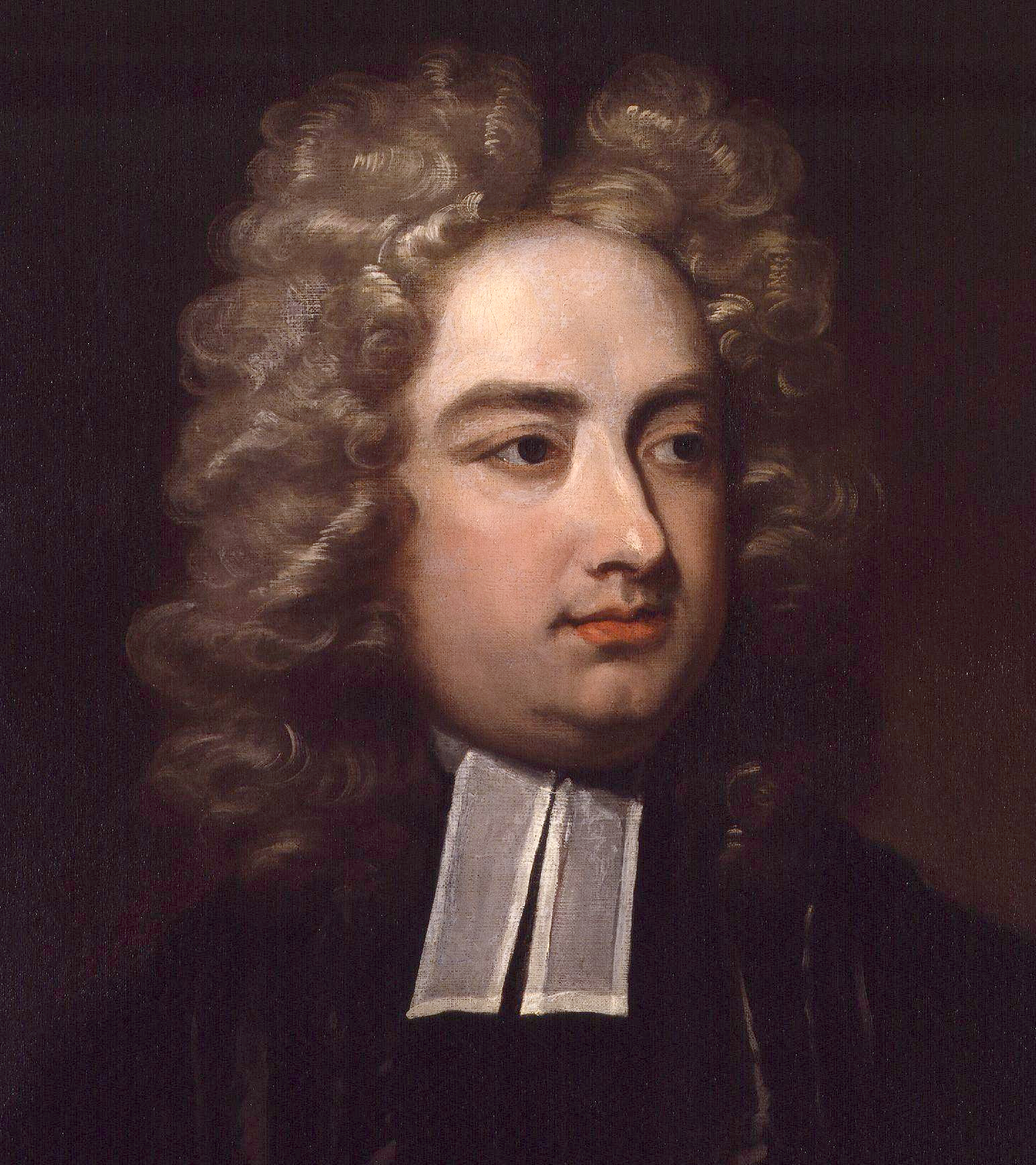 |
| Jonathan Swift by Charles Jervas |
Have you ever considered eating a baby for food? Jonathan Swift proposed that this was the way to overcome the problem of overpopulated poor people in his society of Scotland. Some may say this is wrong. Some may actually entertain the thought. The audience was the rich who despised the poor and didn’t want them overpopulating their society. They were the people Swift was trying to get the attention of and they would take this in those two ways. The whole reason he wrote “The Modest Proposal” the way he did was to over exaggerate the overpopulation and to give a satirical way to solve that problem. Swift’s proposal was ineffective in persuading his audience because it was too satirical, overlooking the real problem, and playing it down as if it wasn’t a problem.
Saturday, February 23, 2013
"A Modest Proposal" By Jonathan Swift
.png) |
| By OpenStreetMap -- Ireland |
Is this a joke? That was the first question that went through my head. Obviously, it was.
The problem that Swift is identifying in his society is over population and also the poor economy of the society. Swift wants to fix this problem in his own way. His way is to eat the babies. Now, not just any babies. He thinks that those who are wealthy can buy babies who have been "plumped up" (so to say) because they are just as good nutrition as cows and other meats they ate during those times.
Honestly, this suggestion is not serious. However, he makes it seem VERY serious but still not serious. That probably sounds really confusing, and it does (haha). The purpose, I think, was to show the issues in a lighthearted way that will still get the point across. He is making fun of this over-population as a problem by over exaggerating a way to get it to disappear. "Hey, too many people? Let's eat the babies!" is basically what he is saying. That isn't what he is talking about, though. What he is actually talking about is how the poor are being treated and how it would almost seem ok to eat their babies, almost to put them out of their misery so to say.
His solution is not in any way logical. The kind of evidence that he supports is, well, there are a lot of babies. What are they going to do with all of them? They aren't useful just being babies, BUT, if they could sell them to the rich THEN the poor mothers would have money and the rich would have a good supply of food.
Overall, I really didn't like this but - its not really my opinion that counts. I think that Swift definitely did a good job at showing how outrageous people can be when they see a situation like the poor being over populated, but also adding humor to it, satire rather.
Thursday, February 14, 2013
Rhetorical Analysis
Arizona Title Loans Ad
Here is the video, below.
This ad was not very effective for me at all. Honestly, I didn't really understand the ad. I mean, I understood it - but I didn't get how it would make any one want to get loans from this place rather then some other place. The audience is obviously men, and probably young adults. It's appeals were really all emotional, so ethos based. Without that appeal, this ad would be nothing. I think that this ad was trying to appeal to the thought that it is, like it says, no strings attached. However, the way they portrayed that was by a woman, who was attached to the man (in one way or another, it doesn't really say why) and it turns out to be the lesser attractive woman. This would appeal to a guy who maybe has had that happen to him before. The purpose is to get the audience to want this loan company, because they would not pull strings out after the fact.
It, however, was very ineffective on me.
Thanks!
Tuesday, February 5, 2013
Starting my Analysis
Bartleby.. My Analysis thus far...
By Elizabeth London
Well...My analysis..
I just started it today (hehe), however I have been thinking about what stand I will take considering the thesis that I chose. The thesis I chose wasn't necessarily the stand that I took on the short story - however - I don't know what my stand really is. I was all over the place while reading the story and have yet to compress it all into one stand rather than a jump from place to place.
Anyway, the thesis that I chose was this: Bartleby is the hero of Melville’s story in his refusal to participate in a workplace that represents the sad, dreary atmosphere of a bureaucratic, industrialized society. He is the only one standing up to a society that is increasingly oppressive to workers.
This seemed like an interesting stand, and I wanted to take the challenege of proving the thesis correct, even if that wasn't my stand, because it was a stand in the least. I like the idea of the challenge. It is almost like a debate with myself.
I am thinking about approaching this in a way of showing Bartleby, and then showing reactions to him (whether it be from his coworkers Nippers and Turkey, or from the people in the building, or from his boss - who I like to call Mr. Wall-Street), and then showing how that relates to him being a hero in the dreary workplace - vaguely my idea is that he stops the ho-hum and makes people rethink what they are doing all day. For example, it makes Mr. Wall-Street stop in his tracks and go out and get coffee instead of slumping at his desk and making his assistants do it.
I have written parts of my outline, although, I rarely stick to my outlines so I keep them as flexible as possible. I have a really creative mind and it usually just goes where it wants and I refine later on. That has worked pretty well for me and in this instance I just need to make sure I remember to cite the book and not work just based off my opinions, since it is an analysis I need to work to analyze for it to be credible! :)
Well, that is all I have to say at this point! Let me know if you guys have any suggestions/comments/whatever else about the direction my essay seems to be going!
Thanks
Toodle-oo!
Elizabeth
Friday, February 1, 2013
Bartleby
Bartleby, The Scrivener: A story of Wall-street
by Herman Melville
Analysis by Elizabeth London
 |
| Author Unknown |
I would prefer not to. This was such a profound thing in the text. The importance of this passage is that it is the first time that Bartleby had refused to do something that his boss asked him to do. For this post I am going to refer to him as Mr. Wall-street. This passage shows the true reality of Bartleby. He had worked so well up to this point and then all of a sudden he "preferred not to". This was something that Mr. Wall-street could not comprehend. He had no idea why his employee would prefer not to do something he was getting paid to do. This causes the question to rise: Why did Bartleby prefer not to? This question.. sadly, is not answered in the text but it is a question I thought of the entire time I read.
The importance this brings about is the importance of Bartleby's character development. If Bartleby had never said "I would prefer not to" well, there wouldn't really be a story. The fact that he says this, over and over again really, shows that Bartleby is not there to work, but rather to just stay. Bartleby had found where he was planning on staying for the rest of his life and he wasn't going to let anything get in the way of that, even that his boss wanted him to work. He just preferred not to and that was that.
Bartleby was a very odd character. He didn't do what he was told and his only response for a long time was "I would prefer not to". What does that say about Bartelby? I believe that says that the work was not of any importance to him. He worked just long enough to be wanted by his boss.. but then decided he didn't want to work after that.
I found myself during this story going back and forth between feeling sorry for Bartleby to feeling disgust at what he was doing. This has a lot to do with the fact that he was meandering around "preferring not" to do anything that he was asked to do. At the same time, however, he had no where else to be and he didn't want to go anywhere else anyway.
Bartleby was a very complex story and this little passage shows just a little bit of that complexity that Bartleby himself caused.
Here is a video for your enjoyment. I think it really depicts Bartleby well.
Friday, January 25, 2013
Subscribe to:
Posts (Atom)